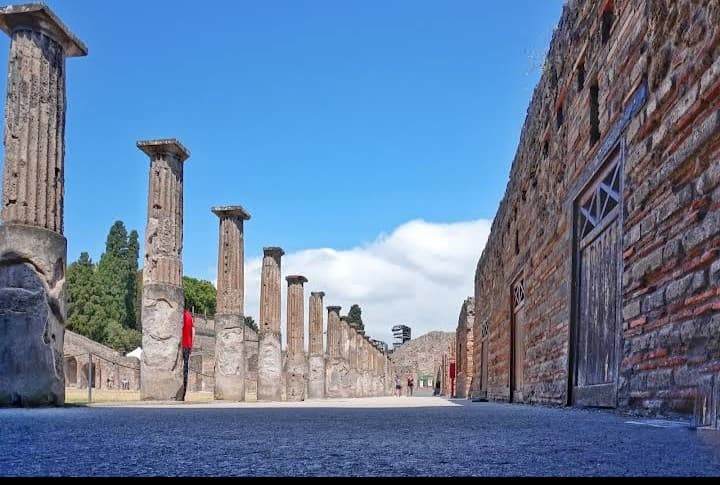
Pompeii
Frozen Roman city reveals ancient life in detail
Walking through Pompeii feels like time travel without the machine. This Roman city, frozen mid-conversation by Mount Vesuvius in 79 AD, offers the most intimate glimpse into ancient daily life you'll find anywhere. Street vendors' counters still hold their marble serving holes. Brothel walls display explicit frescoes and graffiti complaints about service. Private homes reveal family shrines and elaborate garden designs. It's not just ruins — it's an entire civilization caught in a moment, preserved under volcanic ash for nearly 2,000 years.
Best Months
APR · MAY · JUN · SEP · OCT
~25°C · high crowds
Culture & Context
ORDINARY LIVES PRESERVED
Pompeii isn't just a ruin. It's a whole Roman city, flash-frozen in 79 AD when Vesuvius buried it under 13 to 20 feet of ash and pumice. Around 2,000 people who didn't flee were asphyxiated where they stood.
What makes it different from every other ancient site you've walked through is that Pompeii was an ordinary place. Not a palace, not a temple complex. Traders, bakers, brothel-goers, graffiti writers — normal people living normal lives.
That ordinariness is what hits you. You're walking on streets with actual chariot ruts worn into the stone. You can read the election slogans painted on walls.
You see fast-food counters (thermopolia) still with the holes cut for the serving pots. About two-thirds of the city has been excavated, and archaeologists are still actively digging. New discoveries come out almost every year.
The modern town is called Pompei (one 'i') — this is how Italians distinguish the living town from the ancient site. The region sits in Campania, Naples' territory, and the whole area has a proud, stubbornly local identity shaped more by Neapolitan culture than anything coming from Rome. People here take food, family, and football seriously.
The Catholic faith runs deep too: the Sanctuary of the Virgin of the Rosary sits right in the modern town and draws pilgrims year-round.
Local Customs
DINNER AT EIGHT PM
Dinner doesn't happen before 7 or 8pm. Showing up at 6pm will get you a politely closed door or a pity seating. Adjust your clock..
Espresso is consumed standing at the bar. It costs around €1.20 that way.
Sit down and the same cup becomes €2-3. Nobody judges you for sitting, but locals rarely do.. Do not buy tickets from anyone outside the train station or near the site entrances.
Street sellers near Pompei Scavi station are a known problem. Buy only through Vivaticket online or at the official ticket offices inside the archaeological area at Porta Marina, Piazza Esedra, or Piazza Anfiteatro.. The first Sunday of every month is free entry to Pompeii.
Great for your wallet, brutal for your nerves. No advance booking available that day — it's first-come, first-served, and it gets packed.. Tickets from March 2026 are nominative, meaning your name is printed on them.
You may be asked to show ID at the gate. Bring your passport or a national ID card.. In Campania, the verb 'tenere' (to hold/keep) is used where standard Italian would use 'avere' (to have).
So you'll hear 'tengo fame' (I hold hunger) instead of 'ho fame' (I am hungry). Don't correct it — that's just how it sounds here.. Bags and large backpacks must be checked at the entrance cloakroom.
This is free. Don't fight it, just factor in the extra few minutes.. Re-entry with the same ticket is not permitted.
If you leave for lunch in town (smart move), you'll need to buy a new ticket to go back in.
Safety
WATCH PICKPOCKETS & TERRAIN
Pompeii town itself is generally safe to walk day or night. Standard awareness applies — keep bags close, don't flash expensive cameras or phones in obvious ways. The bigger concern is the Circumvesuviana train.
Pickpocketing on the tourist routes (Naples to Sorrento line, which passes Pompei Scavi) is genuinely common. Wear your bag across your chest, don't use back pockets, and pay attention when carriages get crowded. Never buy tickets from anyone outside the train station or approaching you near the site entrances.
The official ticket offices are only inside the archaeological area at Porta Marina, Piazza Esedra, and Piazza Anfiteatro. Street sellers near Pompei Scavi station are a known tourist trap. Inside the site: the terrain is very uneven.
Ancient cobblestones, stepping stones, and broken paving make it tricky with bad ankles or inappropriate footwear. Shade is scarce. In summer, temperatures inside the ruins easily hit 35°C (95°F).
Bring a hat, sunscreen, and refillable water bottle — there are free drinking fountains across the site. The on-site cafeteria is expensive and mediocre. Pack lunch or eat in the modern town outside.
Also: the site closes on Christmas Day and New Year's Day. Double-check the official site (pompeiisites.org) before you go, as closures can happen with little notice.
Getting Around
CIRCUMVESUVIANA TRAIN CHEAP
The cheapest and most practical way in is the Circumvesuviana train from Naples. Depart from Napoli Porta Nolana or Garibaldi station, take the L1 line to Pompei Scavi Villa dei Misteri — about 35-40 minutes and €3.40 each way.
The station drops you right outside the Porta Marina entrance. From Sorrento it's 30-35 minutes on the same line. The Circumvesuviana has a well-documented pickpocket problem on the tourist routes.
Keep your bag in front of you, don't put your wallet in a back pocket, and pay attention on crowded platforms. Arriving by car, take the A3 autostrada Napoli-Salerno and exit at Pompeii Ovest. Parking Zeus is about 400 meters from the main entrance.
If it's full, there's another lot near the Amphitheatre on Via Roma. From Rome, the fastest route is a Frecciarossa high-speed train to Naples Centrale (about 70 minutes), then the Circumvesuviana from there. Total journey each way is around 2.
5 hours — doable as a day trip but leaves roughly 3-4 hours at the site, which is tight. An overnight in Naples solves this entirely. Inside the site, the official Pompeii Artebus shuttle connects Pompeii with the other Great Pompeii sites (Oplontis, Boscoreale, Stabiae).
Note it has luggage storage but no disabled access. There are three entrances to the ruins: Porta Marina (most popular, closest to train station), Piazza Anfiteatro (eastern end, good for the amphitheatre and Garden of Fugitives), and Piazza Esedra (access to the Antiquarium). For the afternoon slot, the Piazza Anfiteatro entrance tends to be less congested.
Useful Phrases
Money-Saving Tips
- 1.Buy the combined Pompeii-Herculaneum-Villa Oplontis ticket for €22 instead of separate entries
- 2.Pack lunch and water — on-site food is overpriced and limited to basic snacks
- 3.Free entry on the first Sunday of each month October through March, but expect massive crowds
- 4.Audio guide rental is €8 but you can download the official Pompeii app for free with basic info
- 5.Stay in Naples rather than tourist-heavy Sorrento — hotel prices are 30-40% lower
- 6.Take the slow Circumvesuviana train instead of expensive tour buses — it's €2.80 vs €50+
Travel Tips
- •Visit during shoulder seasons (April-May, September-October) for perfect weather and smaller crowds
- •Bring a portable phone charger — you'll take hundreds of photos and GPS drains battery quickly
- •Wear closed-toe shoes with good tread — ancient stones are uneven and can be slippery when wet
- •Download offline maps before entering — cell service is spotty among the ruins
- •Start with the Forum and work your way through chronologically for better historical context
- •Allow 4-5 hours minimum — rushing through Pompeii means missing incredible details
- •Book the 'Behind the Scenes' tour for access to normally closed areas and storage facilities