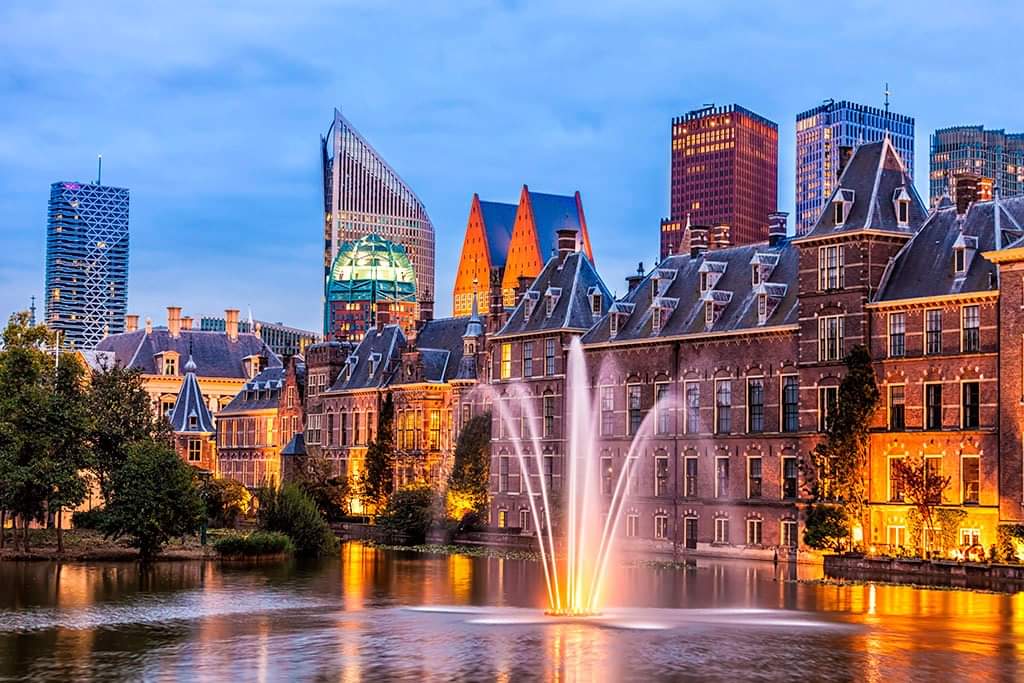
The Hague
International city of peace, justice and royal elegance
The Hague doesn't try to be Amsterdam. And that's exactly why you should visit. This is where Dutch royalty lives, where international justice gets decided, and where you can walk from a Vermeer masterpiece to a seaside resort in 20 minutes. The city balances serious diplomatic business with serious fun — think world-class art museums, royal palaces you can actually visit, and Scheveningen beach just a tram ride away. Sure, it's more buttoned-up than Amsterdam's chaos, but that refined elegance is precisely the point. Here's your guide to Netherlands' most sophisticated city.
Best Months
APR – SEP
~20°C · moderate crowds
Culture & Context
PARLIAMENT, NOT CAPITAL
The Hague (Den Haag to locals) carries a specific identity crisis that actually works in its favor. It's not the capital — Amsterdam holds that title — but it runs the country. The Dutch parliament, 190+ nationalities, the International Court of Justice, Europol, NATO offices: all of it is here.
The city knows it's serious business, but the people aren't. Locals are direct to the point of bluntness — the Dutch call it "recht voor z'n raap" (straight to the point), and it applies in shops, at work, and over dinner. Don't mistake frankness for rudeness.
And there's a real local pride here, separate from the Amsterdam hype. Hagenezen (people from The Hague) will be quick to remind you their city has a beach, a royal palace, world-class museums, and none of Amsterdam's overcrowding. They're not wrong.
Local Customs
SPLIT THE BILL
Splitting the bill is completely normal and expected, even among close friends. The Dutch use the Tikkie app to request exact amounts. Don't take it personally..
Three kisses on alternating cheeks is how friends greet each other — start with the right cheek. Strangers and business contacts get a firm handshake instead.. Punctuality matters.
Dutch people schedule social plans in their 'agenda' weeks ahead. Showing up late without warning reads as disrespectful, not relaxed.. 'Doe normaal' is a real cultural pillar.
It roughly means 'just be normal' — as in, don't show off, don't be loud, don't make a scene. Restraint is respected.. Tipping is not mandatory.
Round up the bill or leave 5–10% if the service was genuinely good. Leaving nothing after fine dining is not rude by Dutch standards.. Water at restaurants costs money — expect €2–3 per bottle.
Tap water is perfectly safe to drink; bring a reusable bottle to save.. Cycling is the default mode of transport. Watch yourself on cycle paths — they are NOT pedestrian paths, and locals will ring their bell at you with zero patience..
Shops generally close early by Southern European standards. Most close by 6pm on weekdays, shorter hours Saturday, and many don't open until noon on Sundays.. Almost all public transit requires a card or contactless payment.
Cash is not accepted on HTM trams or buses — full stop.
Safety
VERY SAFE, MINOR THEFT
The Hague ranks consistently among the safest cities in the world — the US State Department rates it LOW-threat for political violence. The Interpol offices, NATO presence, and 170+ embassies all mean a heavy but largely invisible security infrastructure. For tourists, the realistic concerns are minor.
Pickpocketing happens around Den Haag Centraal station, on crowded trams, and in Scheveningen during peak summer. Keep your phone in a front pocket and bags closed in those areas. Bike theft is extremely common — locals say if your bike is worth more than €500 and you park it unlocked, it's gone.
Use a solid U-lock, not just the wheel lock. The area around the train stations (particularly Hollands Spoor at night) and Laakkwartier can feel uncomfortable late in the evening. Nothing dangerous by major European city standards, but worth noting.
Zuiderpark at night is also better avoided. Schilderswijk has a rougher reputation among some locals, but daytime visits to the Haagse Markt are completely fine and genuinely worth doing. Tap water is safe to drink.
Scams are uncommon but not absent: watch for distraction techniques in busy transit areas and don't use unofficial taxis.
Getting Around
TRAMS & BICYCLES
The main local transit operator is HTM, running 12+ tram lines and numerous buses. You don't need to buy an OV-chipkaart for short visits anymore. Just tap your contactless debit or credit card (Visa, Mastercard, Maestro) directly on the card reader when you board and when you exit.
The app 9292.nl plans your journey across all Dutch transit. Two main train stations connect The Hague to the rest of the Netherlands: Den Haag Centraal and Den Haag Hollands Spoor (HS).
Rotterdam is 25 minutes away; Amsterdam is about 50 minutes on the Intercity. Trams to Scheveningen beach run every 10 minutes from both stations and take about 15 minutes (tram lines 1, 9, 11, 12, 17). In summer, the Strand Express runs non-stop between Den Haag CS and Scheveningen, cutting the trip to 10 minutes.
Night buses (HTMBuzz) run on Friday and Saturday nights, meeting at Buitenhof in the city center hourly — tickets start at €5. The Tourist Tram is a genuine 1950s-era cream-and-green PCC tram doing a hop-on hop-off loop between Centrum and Scheveningen, running every 30 minutes from 10:15 to 16:45 on Saturdays and Sundays from April 4 to October 31, 2026 (plus some public holidays). Charming, slow, worth it once.
Cycling is the honest answer for getting around — the city is flat and has well-maintained cycle paths everywhere. Bike theft is a real problem; a cheap, ugly bike with a solid lock is smarter than a nice one. Donkey Republic bike-share is available via app if you want something casual.
Driving in the center is not worth the stress. Tram rails, cyclists everywhere, and limited parking make it more headache than it's worth.
Useful Phrases
Itineraries coming soon
We're working on adding amazing itineraries for The Hague. In the meantime, try the app to create your own!
Money-Saving Tips
- 1.Many museums offer combo tickets — the Mauritshuis and Escher Museum package saves €5
- 2.Wednesday and Saturday markets sell local cheese and produce at half the supermarket price
- 3.Scheveningen beach clubs charge €15+ for loungers, but the public beach areas are completely free
- 4.Tram day passes cost €8 versus €3.20 per single journey — breaks even after 3 rides
- 5.Restaurant lunch menus typically cost 40% less than dinner at the same places
- 6.The Hague Pass includes public transport and museum entries for €45/day — worth it if hitting 3+ attractions
Travel Tips
- •Book Mauritshuis tickets online — they limit daily visitors and sell out during peak season
- •Scheveningen gets packed on sunny weekends — go early morning or late afternoon
- •Many government buildings offer free tours, but book weeks in advance through official websites
- •The royal palaces have different opening schedules — check before planning your route
- •Tram 1 runs every 5 minutes during the day but stops earlier on Sundays
- •Restaurant kitchens close early (9pm typical) — don't expect late dinners like in southern Europe
- •Beach weather changes fast — pack a light jacket even on sunny days
Frequently Asked Questions
Explore The Hague
BUILD YOUR THE HAGUE PLAN
Insider picks, smart timing, and a plan ready when you are.