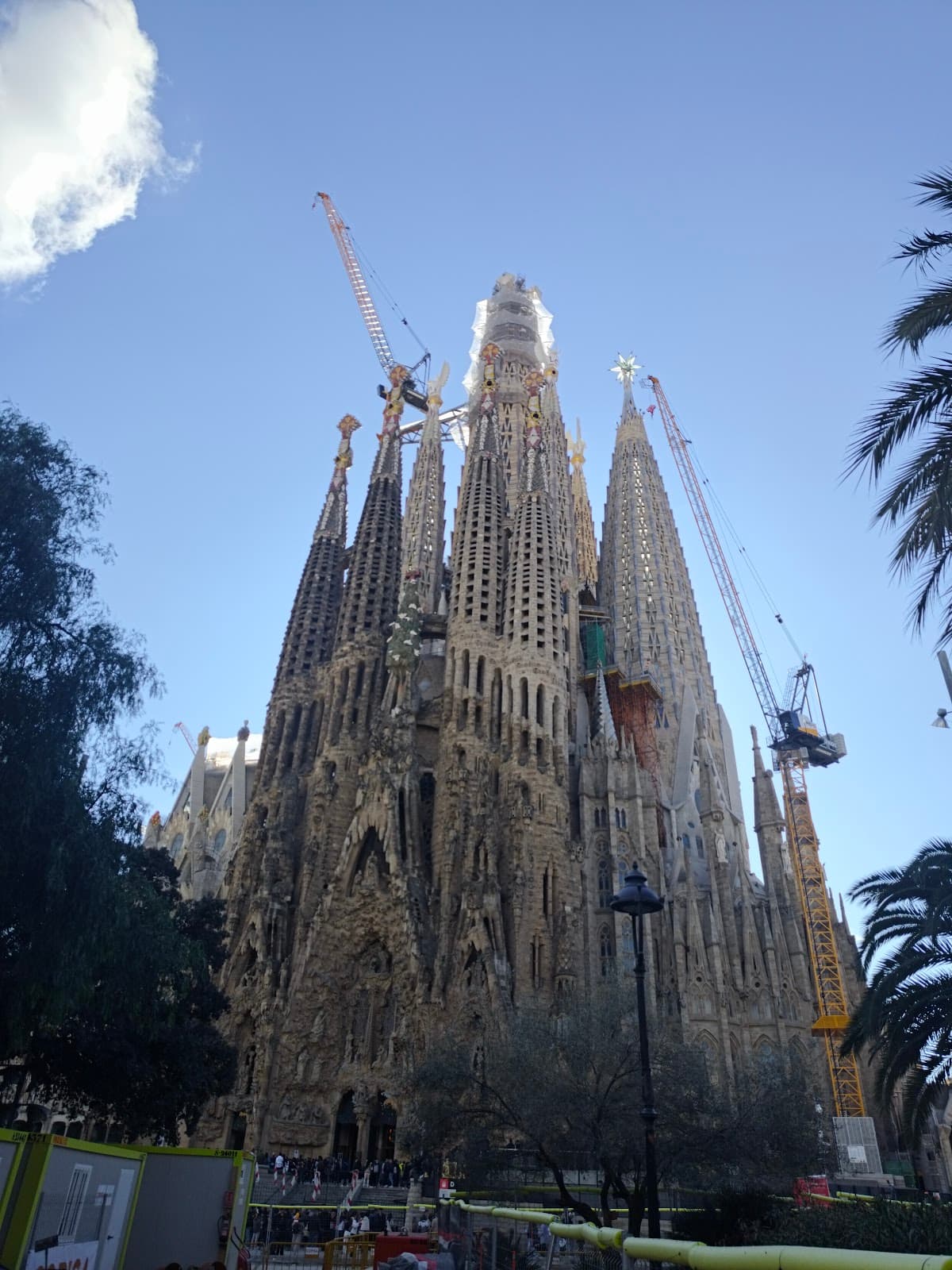
Sagrada Familia
Gaudi's unfinished masterpiece defying architectural convention in Barcelona
Look, you've seen the photos. But nothing prepares you for standing beneath those impossibly twisted spires, craning your neck until it aches, trying to make sense of what Antoni Gaudi dreamed up more than a century ago. The Sagrada Familia isn't just Barcelona's most famous church — it's architecture that breaks every rule, a fever dream in stone that's been under construction since 1882 and still isn't finished. Every surface tells a story, every column reaches toward heaven like a forest of stone trees. This is where religious devotion meets artistic rebellion, and honestly? It's unlike anything else on Earth.
Culture & Context
MUGHAL LEGACY ALIVE
Agra was the Mughal capital under Akbar, Jahangir, and Shah Jahan, and that history isn't just in the guidebooks. It shows up in the food (slow-cooked kebabs and fragrant biryanis descended from royal kitchens), the craftsmanship (marble inlay work using pietra dura technique brought by Persian artisans), and the city's underlying religious mix (about 80% Hindu, with a significant Muslim community). Three UNESCO World Heritage Sites sit within the same city: the Taj Mahal, Agra Fort, and Fatehpur Sikri.
The Taj was commissioned in 1632 by Shah Jahan as a mausoleum for his wife Mumtaz Mahal and completed around 1653. Agra Fort served as the main Mughal royal residence before Delhi, and Shah Jahan spent his final years imprisoned inside it, reportedly able to see the Taj from the Musamman Burj tower. Fatehpur Sikri, 40 km west, was Akbar's ambitious short-lived capital from 1571–1585, abandoned not long after construction.
The city's signature sweet, petha (translucent candy from ash gourd), has been made here for centuries. Kinari Bazaar, near Agra Fort around Jama Masjid, is one of the oldest surviving markets. Classical Kathak dance has roots in Agra's Mughal courts.
Local Customs
SHOES OFF ALWAYS
Shoes off before entering any temple, mosque, or religious site — this includes parts of the Taj Mahal complex. Many sites have lockers at the entrance. Carry socks if the marble gets hot..
Dress modestly. Cover shoulders and knees, especially at monuments. Women in particular should consider a shawl or scarf — practical against sun, dust, and the occasional unwanted stare..
Bargaining is standard in markets. Starting at 40–50% of the asking price is reasonable. Keep it polite; the conversation can be genuinely enjoyable..
Rickshaws and auto-drivers often get commission from specific shops. The classic move: 'the road to your hotel is closed, but I know a good market nearby.' Agree on a price upfront and stick to your plan..
Pre-book Taj Mahal tickets online at the ASI website. It skips the queue and saves considerable time, especially at sunrise. The ticket is valid for one visit on the day specified only..
Tipping: 10% at restaurants (check whether a service charge is already on the bill). ₹50–100 per bag for porters. No need to tip rickshaw drivers beyond the agreed fare..
The Taj Mahal is closed every Friday for prayers.. Drink only bottled water — check the seal. This applies to brushing teeth too.
Stick to street food that is cooked fresh in front of you.. Download Uber or Ola before arrival. Far better than hailing random auto-rickshaws if you want a transparent fare.
InDrive also works and lets you negotiate with drivers.. Photography is included in the Taj entry ticket, but tripods are not permitted inside the complex. Drones require special prior permission from authorities.
Safety
WATCH FOR TOURIST TRAPS
Agra is considered one of the safer Indian cities for tourists in 2026. Violent crime against tourists is rare, and the US State Department rates India overall at Level 2 (exercise normal precautions). Major tourist circuits including Agra remained fully operational and unaffected by Operation Sindoor (a targeted anti-terror operation in border-sensitive regions, May 2026). The Taj Mahal has airport-style security: metal detectors, bag scanners, and constant CISF patrols. An incident earlier in 2025 involving a security scare led to a thorough sweep but no danger to visitors — authorities took it seriously.
The real risks are financial, not physical. Agra has arguably the highest tourist-trap density in India. The main scams: (1) the "free guide" who demands large payment afterward; (2) taxi drivers claiming the road to your hotel is closed, rerouting you to commission shops; (3) friendly locals leading you to "family workshops" selling overpriced or counterfeit marble (cheap soapstone sold as genuine Makrana marble); (4) credit card fraud — never let your card out of sight at shops. Pre-agree all transport prices. Buy Taj tickets online. Decline all unsolicited help politely but firmly. Use Uber/Ola over flagged-down autos. Women should dress modestly and avoid unlit areas at night. Tourist police are stationed at the Taj Mahal gates. Emergency numbers to save: 112, 108, 1090.
Getting Around
METRO & UBER
Getting to Agra: Most international travelers fly into Delhi (DEL) and connect to Agra. The Gatimaan Express from Delhi Nizamuddin is the fastest option (1 hour 40 minutes, $6–12), though it runs limited daily departures. Book via irctc.co.in or Cleartrip in advance — popular departures sell out. The Yamuna Expressway by private car takes 3–4 hours ($47–65) and is the most flexible option for families or groups. Buses from Delhi run 4–5 hours and cost ₹200–3,000 depending on class; the main Agra bus terminal is ISBT.
Getting around Agra: The Agra Metro (operational since March 2024) is the cleanest and most transparent option for the tourist corridor. The Blue Line priority section connects 6 stations including Taj East Gate, Agra Fort, and Agra Cantt Railway Station for ₹11–21 per ride. It uses NCMC smart cards. For everything else, Uber and Ola are the sensible default — GPS-tracked, price-transparent. Auto-rickshaws are fine for short hops if you negotiate firmly upfront: expect ₹50–100 from Agra Fort to the Taj, ₹100–150 from Agra Cantt station to the Taj. Cycle rickshaws work well for the narrow lanes around Kinari Bazaar and Taj Ganj. For Fatehpur Sikri (40 km), hire a full-day car or taxi: ₹1,200–1,800 round trip is typical. Walking between major monuments is not practical given the distances and heat — don't try to walk from Agra Fort to Mehtab Bagh in July.
Useful Phrases
Itineraries coming soon
We're working on adding amazing itineraries for Sagrada Familia. In the meantime, try the app to create your own!
Money-Saving Tips
- 1.Book tickets online in advance to avoid the €3 surcharge for buying at the door
- 2.Skip the expensive audio guide and download the free Sagrada Familia app instead
- 3.Combined Gaudi tickets save about 20% if you're visiting multiple sites
- 4.Early morning or late afternoon visits cost the same but offer better lighting and smaller crowds
- 5.Student discounts available with valid ID — saves about €4 on basic entry
- 6.Under 11s get free entry, 11-17 year olds pay reduced rates
- 7.Avoid the overpriced cafeteria inside — grab coffee at Bar Mut across the street for half the price
Travel Tips
- •Download the official Sagrada Familia app before visiting — it has detailed explanations and AR features
- •Bring a portable phone charger — you'll be taking photos non-stop
- •Visit on a sunny day if possible — the stained glass windows are the real show
- •Allow at least 2 hours for a proper visit, 3 if you're going up the towers
- •The gift shop has unique Gaudi-inspired items, but prices are tourist-level inflated
- •Construction noise can be loud during weekday mornings — just part of the authentic experience
- •Wear comfortable shoes — lots of walking and climbing if you do the towers
- •The nearby Plaça de la Sagrada Familia has benches and shade for a post-visit rest
Frequently Asked Questions
Explore Sagrada Familia
BUILD YOUR
SAGRADA FAMILIA PLAN
Insider picks, smart timing, and a plan ready when you are.
Start Planning