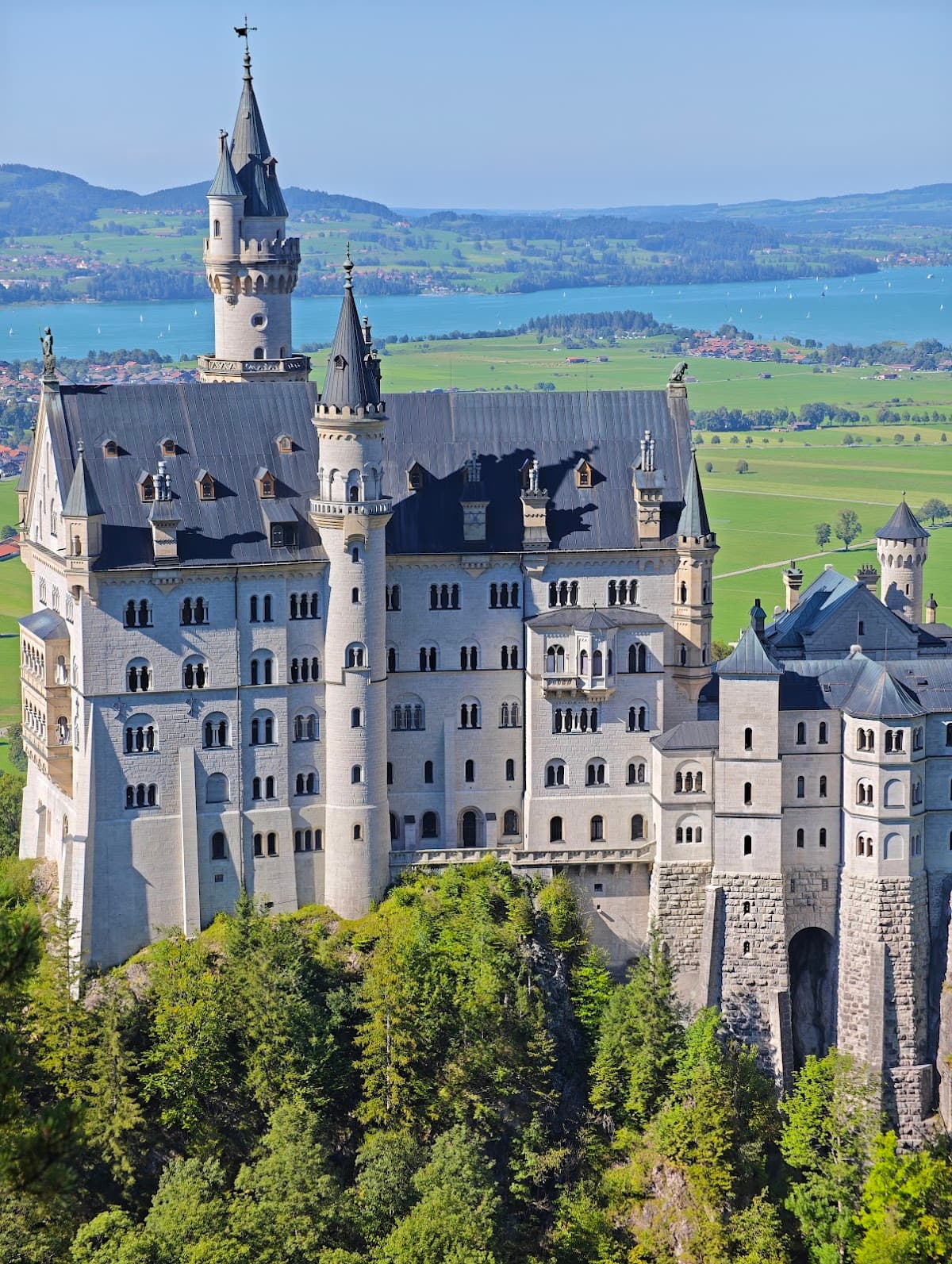
Neuschwanstein Castle
Bavaria's fairy-tale castle inspiring Disney's magical kingdom
King Ludwig II built this white limestone fantasy in the Bavarian Alps, and honestly? The man had vision. Perched on a rocky outcrop near Füssen, Neuschwanstein Castle looks like it was torn from the pages of a Brothers Grimm story. Walt Disney certainly thought so when he used it as inspiration for Sleeping Beauty Castle at Disneyland. But here's the thing — Ludwig never lived to see his dream completed. He died under mysterious circumstances in 1886, just before construction finished. Today, 1.4 million visitors climb the winding path to this 19th-century masterpiece every year. The castle's Neo-Romanesque towers and turrets rise against a backdrop of snow-capped peaks and emerald forests. Inside, you'll find rooms dripping with medieval romanticism — think swan motifs everywhere (Ludwig's obsession), a artificial grotto, and a throne room that never got its throne.
Best Months
MAY – OCT
~20°C · high crowds
Culture & Context
LUDWIG'S UNFINISHED FANTASY
Neuschwanstein Castle sits above the tiny village of Hohenschwangau in southern Bavaria, about 120 kilometers southwest of Munich. King Ludwig II commissioned it in 1869 as a personal fantasy retreat, inspired by the operas of Richard Wagner. He never got to enjoy it much.
Ludwig died under mysterious circumstances in 1886, and the castle opened to tourists just six weeks later. It was unfinished then and technically still is. The throne room has no throne.
That detail tells you a lot about the man who built it. The castle draws around two million visitors a year, which makes it one of Germany's most visited landmarks. Walt Disney reportedly used it as direct inspiration for Cinderella's Castle.
Look closely at the two side by side and you'll see it. The whole Hohenschwangau area is pure tourist infrastructure at this point, but the landscape around it, the Alpine lakes, the gorge below Marienbrücke, the forested hills, is genuinely striking and worth the trip even if the castle itself disappoints some people after the hype.
Local Customs
BOOK WEEKS AHEAD
Book your Neuschwanstein tickets weeks in advance, not days. During peak summer (July-August), the castle gets 6,000+ daily visitors. Walk-up tickets at the Ticket Center from 8 AM sell out fast, sometimes before 9 AM.
Online booking adds a €2.50 fee but it's worth every cent.. The guided tour inside is exactly 30 minutes and starts on time.
Show up late and they turn you away. No exceptions. Arrive at the castle entrance 10-15 minutes before your slot, which means leaving Hohenschwangau village at least 90 minutes before your ticketed entry time..
No photos inside the castle. The guards enforce this. Save your phone battery for Marienbrücke..
Bavarian tipping customs are relaxed by American standards. Rounding up the bill or leaving 5-10% is normal. Do it in cash, hand it directly to the server, and say 'stimmt so' (keep the change) rather than leaving money on the table..
Cash still matters more than you'd expect. Shuttle buses, some cafes, and souvenir vendors near the castle often don't accept cards. Carry €50-100 in small bills..
The Marienbrücke can close without warning in winter when there's snow or ice on it. Check the castle website the morning of your visit if you're going between October and April.. Rucksacks, prams, and bulky bags are not allowed inside the castle.
Plan accordingly or use the cloak facilities.
Safety
WATCH YOUR FOOTING
The area is generally very safe. Standard tourist-area caution applies: keep bags zipped and wear a crossbody bag in the Hohenschwangau village when it's crowded. The main hazards are physical, not criminal.
The path up to the castle is steep and can be slippery in wet or icy weather — wear actual shoes, not sandals. The Marienbrücke sits above a serious gorge. There are railings, but the bridge gets extremely crowded and is narrow.
Don't lean over dramatically for photos. Stay on marked trails. A rockslide off an unofficial trail near Marienbrücke took five years to clear.
Drone flights are strictly prohibited within 2 kilometers of both castles — fines and equipment confiscation are the consequence. Inside the castle, there are nearly 200 stairs to climb, and the building is not fully wheelchair accessible, though an elevator is available for one wheelchair user per tour with advance arrangement. Note that there is a strict no-stopping zone in front of the Ticket Center building — use car parks P1-P4 only.
Getting Around
TRAIN TO FÜSSEN STATION
Getting here from Munich is straightforward, just slow. Take a regional train from Munich Hauptbahnhof to Füssen, about 2 hours, departing roughly every hour. Tickets run €14-17 each way per person. If you're traveling in a group, the Bayern-Ticket covers up to 5 people on all regional trains and most local buses for €29-49 total. Bus 78 (or 73) runs from Füssen station directly to Hohenschwangau village in about 10 minutes, one-way about €2.10. The bus stop is right beside the train station, hard to miss.
Here's the thing for 2026: renovation work on the König-Ludwig Bridge (B16) in Füssen means a one-way traffic closure is in effect from May 4, 2026, until approximately early August. If you're driving or taking a taxi, budget extra time. The bus route may also be affected, so check ahead. Parking at the castle lots costs around €8 for the day. Cars and bikes are not permitted on Neuschwansteinstraße, the actual road up to the castle. From the ticket center, it's a 30-40 minute walk uphill to the castle entrance. A paid shuttle bus runs on demand (not a fixed schedule) and drops you near Marienbrücke, about a 10-15 minute downhill walk to the entrance. Horse-drawn carriages also run, but they're slow, overpriced, and the horses deal with a lot of traffic on a steep road.
Useful Phrases
Itineraries coming soon
We're working on adding amazing itineraries for Neuschwanstein Castle. In the meantime, try the app to create your own!
Money-Saving Tips
- 1.Buy the 14-day Bavarian Palace Pass for €24 if visiting multiple Ludwig castles — it covers Neuschwanstein, Linderhof, and Herrenchiemsee
- 2.Pack lunch from Füssen supermarkets — castle cafe prices hit €12 for basic sandwiches
- 3.Take the Bayern-Ticket for regional trains instead of booking individual tickets — saves €15-20 on Munich day trips
- 4.Stay in Füssen hostels (€25/night) rather than castle-view hotels (€200+) — you'll only see the castle for 35 minutes anyway
- 5.Skip the horse carriage ride — it's €6 for a 10-minute journey you can walk in 30 minutes
- 6.Visit on weekdays in shoulder season (May or October) when some hotels drop rates by 30%
Travel Tips
- •Download the castle's official app for augmented reality features that show rooms as Ludwig envisioned them
- •Bring a portable phone charger — the uphill walk drains batteries and you'll want photos from Marienbrücke
- •Check weather before visiting — fog can completely obscure the castle, and Marienbrücge closes in high winds
- •Learn basic German phrases — many local staff speak limited English, especially at restaurants
- •Wear layers even in summer — Alpine weather changes quickly and the castle interior stays cool year-round
- •Book accommodation early for Oktoberfest season (September-October) when prices triple and availability vanishes
Frequently Asked Questions
Explore Neuschwanstein Castle
BUILD YOUR NEUSCHWANSTEIN CASTLE PLAN
Insider picks, smart timing, and a plan ready when you are.