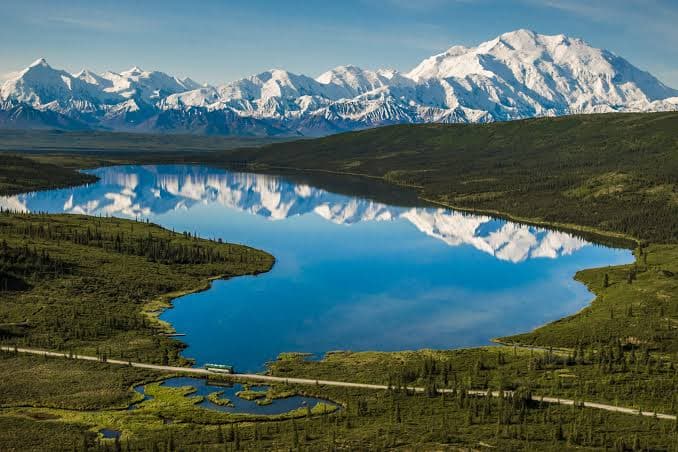
Denali National Park
Alaska's wilderness crown jewel beneath North America's tallest peak
Six million acres of untamed Alaska wilderness stretch out beneath Denali's 20,310-foot summit. This isn't your typical national park — there's exactly one road, and it dead-ends after 92 miles. But that's the point. Denali rewards the patient and the bold with grizzly bears fishing for salmon, caribou migrations that darken the tundra, and silence so complete you can hear your own heartbeat. The mountain itself hides behind clouds 70% of the time, making clear-sky sightings feel like winning the lottery. Come prepared for mud, mosquitoes, and magic.
Best Months
JUN – AUG
~20°C · high crowds
Culture & Context
ATHABASCAN SACRED LAND
This land has been home to Athabascan peoples for thousands of years, long before the park existed. Five northern Athabascan groups have deep ties to the area: the Dena'ina, Koyukon, Lower Tanana, Upper Kuskokwim, and Western Ahtna. Linguists have documented more than 1,650 place names these groups assigned to geographic features within a 100-200 mile radius of the mountain's summit. That's a lot of relationship with a landscape.
The name "Denali" comes from the Koyukon Athabascan word Deenaalee, meaning "the tall one" or "the high one." The park was originally named Mount McKinley National Park when it was established in 1917, after the mountain's colonial name. Alaska officially switched to "Denali" decades before the federal government followed in 2015. Many Alaska Natives consider the mountain a sacred place. There's ongoing conversation about respecting that history, so it's worth knowing before you arrive.
Subsistence practices (hunting, fishing, gathering) remain legally protected for qualifying Alaska Native residents in and around the park today. This isn't ancient history. Families from communities like Nikolai still harvest chinook salmon in summer and moose in fall from these lands. The 49th State Brewery in Healy is named as a nod to Alaska's 1959 statehood, the most recent state to join the union, and that still-new identity matters here. Alaskans are proud of being different from everywhere else, and they mean it.
Local Customs
SAY SNOWMACHINE, NOT SNOWMOBILE
Call it a 'snowmachine,' not a 'snowmobile.' Seriously. Locals notice immediately..
Don't approach wildlife for photos. The 300-yard rule from bears isn't a suggestion, it's law. And moose, despite looking dopey, weigh up to 1,600 pounds and will charge you without much warning..
Buy bear spray before you enter the park. You cannot fly with it. Pick it up in Healy or at the park entrance area.
Keep it clipped to your body on hikes, not buried in your pack.. Stock up on groceries in Anchorage or Fairbanks. The Riley Creek Mercantile is convenient but priced accordingly.
There's a deli at Canyon Market near the park entrance, and it's actually decent.. Book bus tickets and campground reservations early. Mid-July is the most competitive.
Waiting until you arrive often means a 2-3 day wait for your bus seat.. Don't leave food unsecured anywhere. Bear canisters are required for backcountry camping.
Even at frontcountry campgrounds, food storage lockers are there for a reason.. If a ranger gives you a wildlife safety briefing, listen. The Discovery Hike programs pair you with an experienced ranger for off-trail exploration, and the information is genuinely useful..
Respect the bus system etiquette. When you hop off a transit bus to hike, you re-board on a first-come, first-served basis. In peak summer, you may wait an hour or more.
Have snacks and patience.. The midnight sun is real. Bring a sleep mask if you're sensitive to light, even in August..
Don't call Alaskans residents of 'the States' or act like Alaska is a foreign country. It's a point of pride that it's part of the U.S.
— just the most remote, biggest, most independent part.
Safety
MOOSE MORE DANGEROUS THAN BEARS
The big one: cell service disappears inside the park. It works near the park entrance and the commercial corridor known as Glitter Gulch, but goes spotty quickly. Deep in the park, you're fully off-grid. Tell someone your itinerary before heading into the backcountry.
Bears are real. Denali has both grizzlies (mostly open tundra) and black bears (forested lower elevations). The park estimates around 300-350 grizzlies on the north side of the Alaska Range alone. You're required to stay at least 300 yards from any bear and 25 yards from all other wildlife and dens. If a bear doesn't know you're there and you can quietly retreat, do that. Don't run. Running triggers a chase response. Carry bear spray and keep it on your body where you can access it in under two seconds. You cannot fly with bear spray, so buy it in Healy or at the park entrance area before you go out.
Here's the thing people underestimate: moose are arguably more dangerous than bears. They weigh up to 1,600 pounds, four times a Denali grizzly's weight, and will charge aggressively if they feel cornered. If a moose charges, zigzag and put obstacles (trees, rocks, your bus) between you and the animal. Do not stand still.
Mosquitoes peak in June and July and are genuinely relentless. DEET-based repellent is not optional. Long sleeves and pants help too.
Medical services are limited. The Canyon Clinic is seasonal and open daily 9am-6pm during summer. The year-round Community Interior Health Center in Healy (12 miles north) is open Monday through Friday 9am-5pm. Neither has a full doctor on staff. The nearest real hospital is in Fairbanks or Anchorage. For emergencies, call 911; Alaska State Troopers have a post in Healy.
Weather shifts fast and does not care about your schedule. Even in July, temperatures can drop sharply and snow is possible at elevation. Layer. Always carry rain gear on any hike.
Getting Around
BUS & BOOTS ONLY
Getting here takes some planning. The park has one entrance, at Mile 237 on the George Parks Highway. From Anchorage, it's about 240 miles (4-5 hours by car). Fairbanks is 120 miles north, roughly 2 hours. The Alaska Railroad runs between Anchorage and Fairbanks with a stop right at the park entrance, which is genuinely scenic and worth doing at least one direction if your schedule allows.
Inside the park, private vehicles are allowed to drive to Savage River at Mile 15. Beyond that, it's buses, bikes, or boots. In 2026, all bus services go only to Mile 43 due to the road closure. Transit buses (the green ones) let you hop on and off along the park road, which is great if you want to hike sections and reboard. Narrated tour buses have a driver-guide who curates wildlife stops. Both start from the Denali Bus Depot. Book ahead, especially July visits. If you wait until you arrive to buy tickets, you may be waiting 2-3 days.
A free shuttle runs every 15 minutes during peak hours between the Denali Bus Depot/Visitor Center and the Mountain Vista and Savage River Trailheads. Use it.
Bus prices range from about $33 to $144 depending on tour type and distance. Transit buses do not include the park entrance fee in the ticket price, so add $15/person on top. There is an $8.75 fee to cancel or change reservations more than 7 days out, and tickets are nonrefundable inside 7 days.
If you book a minimum of 3 nights at Teklanika River Campground, you're allowed to drive your private vehicle the 29 miles out there yourself. That's one workaround for getting beyond the usual Mile 15 cutoff without riding a bus.
Useful Phrases
Itineraries coming soon
We're working on adding amazing itineraries for Denali National Park. In the meantime, try the app to create your own!
Money-Saving Tips
- 1.Book park bus tours by February to avoid sellouts and higher prices
- 2.Pack all your own food - park store prices run 2-3x normal grocery costs
- 3.Stay in Healy instead of park lodges to save $100+ per night
- 4.Bring a National Parks Annual Pass ($80) if visiting other parks this year
- 5.Buy gas in Fairbanks - stations near Denali charge premium prices
- 6.Camp at Riley Creek for $30/night instead of $300+ lodge rooms
- 7.Bring bear spray from home - it costs $45+ in park stores
Travel Tips
- •Download offline maps - cell service disappears after Mile 15
- •Pack layers for 30-degree temperature swings between morning and afternoon
- •Bring binoculars - wildlife spotting happens at distance on the tundra
- •Carry bear spray and know how to use it properly
- •Book shuttle buses early morning for best wildlife viewing
- •Bring bug spray and head nets for June and July visits
- •Pack rain gear - weather changes fast in the mountains
- •Bring cash - many services don't accept cards
- •Start hiking early to avoid afternoon thunderstorms
Frequently Asked Questions
Explore Denali National Park
BUILD YOUR DENALI NATIONAL PARK PLAN
Insider picks, smart timing, and a plan ready when you are.