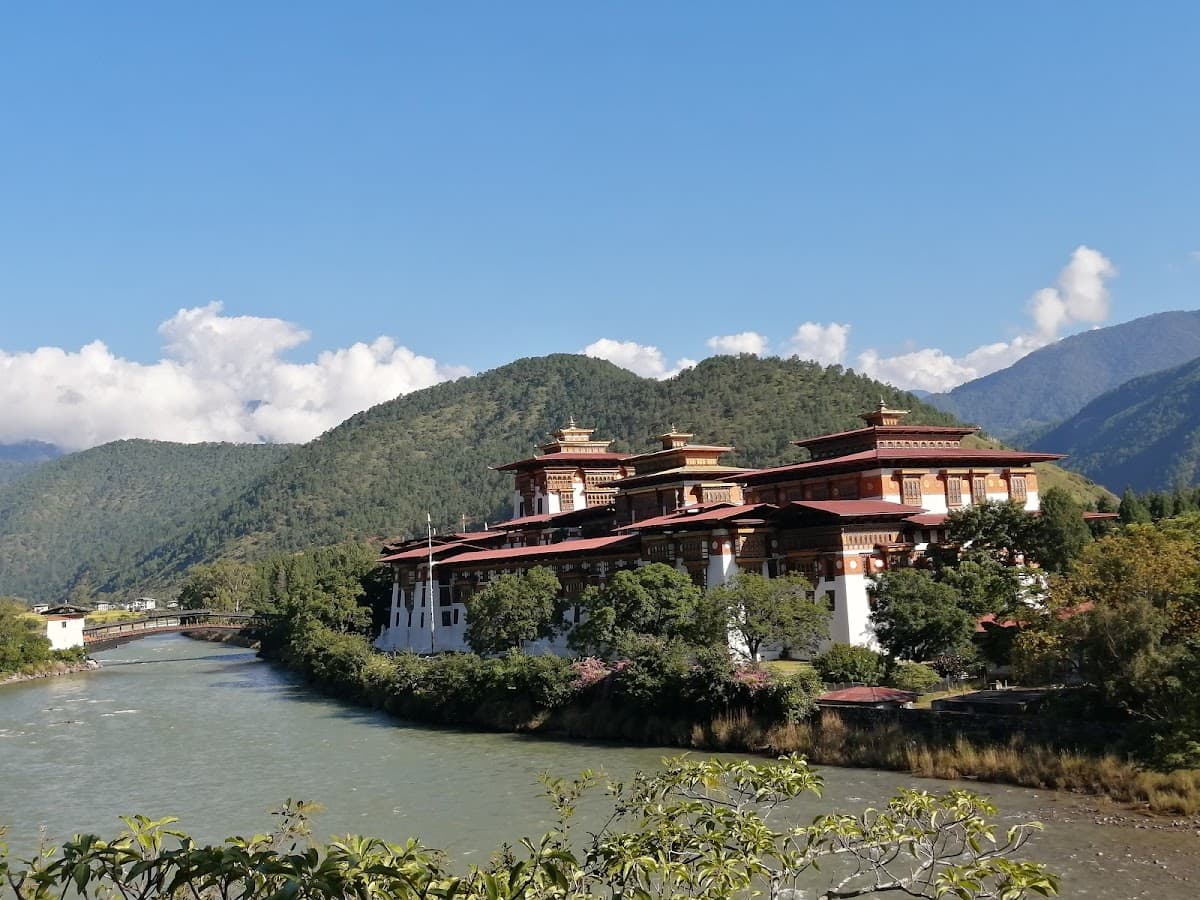
Punakha
Ancient capital where two rivers meet sacred valleys
Punakha sits at the confluence of two rivers like a meditation between mountains. This former capital of Bhutan trades the tourist crowds of Thimphu for something deeper — ancient dzongs that still house monks, terraced fields that climb toward snow peaks, and valleys where prayer flags flutter in mountain wind.
The Punakha Dzong, built in 1637, anchors the town where the Mo Chu and Pho Chu rivers meet. But this isn't just about one spectacular fortress. Walk the suspension bridges that span rushing water. Trek through rhododendron forests to hidden temples. Watch farmers tend rice paddies that have fed this valley for centuries.
Here's the thing about Punakha — it moves at the pace of river water. Slow enough to notice details, steady enough to feel the current of something timeless.
Best Months
MAR · APR · MAY · SEP · OCT · NOV
~25°C · high crowds
Culture & Context
ROYAL CROWNING GROUND
Punakha was Bhutan's capital for over 300 years and every single Bhutanese king has been crowned at Punakha Dzong. The government moved to Thimphu in 1955, but the Chief Abbot (Je Khenpo) and the Central Monastic Body still winter here every year. That's not symbolic — the entire monastic administration physically relocates between the two dzongs on a seasonal cycle, as it has for centuries.
The valley sits at 1,200m, which makes it noticeably warmer than Paro or Thimphu. Banana trees grow alongside rice paddies. It feels subtropical compared to the capital.
The Pho Chhu (male river) and Mo Chhu (female river) converge right at the base of the dzong — the spot has deliberate spiritual geography. Buddhism isn't a tourist backdrop here; it actively shapes the calendar, the architecture, the daily rhythm. Monks in red robes walk paths that locals also use to get to the market.
Archery, Bhutan's national sport, gets played on any flat piece of ground with real competitive seriousness (and some social drinking alongside it).
Local Customs
ADD 'LA' RESPECTFULLY
Add 'la' to the end of greetings and requests — it's a verbal sign of respect. 'Thank you, la' lands differently than just 'thank you.' Locals use it constantly, and visitors who use it get a noticeably warmer reception..
When someone offers you food or drink inside a home, say 'meshu meshu' while covering your mouth with your hands. Decline twice, then accept on the third offer. Refusing outright is considered rude; this ritual refusal then acceptance is the polite form..
Remove shoes before entering any dzong or temple. Bring socks — stone floors get cold, even in warmer Punakha.. Walk clockwise around stupas, chortens, and the interior paths of temples.
This isn't a tourist rule; it's how prayer circuit works in Tibetan Buddhist tradition.. Dress modestly at religious sites — shoulders and knees covered, minimum. The dzong gate wardens will turn you back if you're not dressed appropriately.
Keep a scarf or light layer in your bag year-round for this.. Photography inside prayer halls is usually prohibited. The courtyards are generally fine.
Always check with your guide before pointing a camera anywhere inside a dzong or temple, and never use flash during dances or rituals.. Don't touch anyone's head — it's considered the most sacred part of the body. Don't pat children on the head either, even affectionately..
Give and receive items with your right hand, or use both hands. Handing something to a monk or elder with one casual left-handed flick reads as disrespectful.. Archery competitions are social events and spectators are usually welcome.
If someone invites you to try, do it — even badly. It's one of the few settings where being bad at something earns you more warmth, not less.
Safety
EXTREMELY SAFE
Punakha is extremely safe. Crime against tourists is essentially nonexistent. Bhutan's controlled tourism model means you're always traveling with licensed operators who know the area well, which reduces the usual solo-travel friction significantly.
Solo female travelers consistently report feeling comfortable and secure. A few honest caveats: mountain roads between Thimphu and Punakha via Dochu La Pass are steep, winding, and sometimes affected by landslides during monsoon (July–August). Punakha itself sits at only 1,200m so altitude sickness isn't a concern in the valley, but the Dochu La crossing at 3,050m can cause brief headaches for people arriving from sea level.
Drink water, go slow, you'll be fine. The Mo Chhu and Pho Chhu rivers flood seasonally — the dzong has been damaged by floods historically. Don't wade into rivers during or after heavy rain.
Flash floods can come without warning in the narrow gorges. Stick to established river paths.
Getting Around
GUIDED & WALKABLE
Punakha sits 72km east of Thimphu, a drive that takes 2.5–3.5 hours depending on road conditions and your stop at Dochu La Pass.
There's no airport in Punakha — the only international entry point for Bhutan is Paro airport (Drukair and Bhutan Airlines fly in from Kathmandu, Delhi, Bangkok, Singapore). From Paro, add another hour to the Thimphu–Punakha drive. Shared taxis from Thimphu run to Khuruthang town and cost roughly 200 BTN per seat ($2.
30 USD). Public buses exist but schedules are inconsistent and comfort is basic. Most travelers arrive with a private driver arranged through their tour operator, which is the path of least resistance given Bhutan's tourism structure.
Inside Punakha itself, the town is walkable. The dzong, the suspension bridge, and Khuruthang market are all reachable on foot from the main strip. Chimi Lhakhang involves a 30-minute paddy-path walk from the road.
Khamsum Yulley Namgyal Chorten is a 30-minute uphill hike. River rafting on the Mo Chhu is booked through operators in town — no independent float rentals. A shared taxi from Khuruthang to Thimphu for the day runs around 2,500–3,000 BTN if you're chartering the whole vehicle.
Useful Phrases
Itineraries coming soon
We're working on adding amazing itineraries for Punakha. In the meantime, try the app to create your own!
Money-Saving Tips
- 1.Eat at local restaurants instead of hotels — you'll save 200-300 ngultrum per meal and get better food
- 2.Buy snacks and water at the weekend market rather than hotel shops to cut costs by 50%
- 3.Share taxis with other travelers for day trips — drivers often charge the same for 1-4 people
- 4.Book accommodation directly with guesthouses to avoid online booking fees of 10-15%
- 5.Carry small bills — many vendors can't break 1000 ngultrum notes
- 6.Negotiate taxi fares upfront, especially for longer trips to temples or trekking points
Travel Tips
- •Bring layers — valley temperatures swing 20+ degrees between day and night
- •Pack a good flashlight for evening temple visits and power outages
- •Respect photography rules at dzongs — ask permission and avoid flash inside temples
- •Learn basic Dzongkha greetings — locals appreciate the effort even if your pronunciation is terrible
- •Keep your receipt from the sustainable development fee — you'll need it for temple entries
- •Download offline maps — cell coverage gets spotty in the upper valleys
- •Bring altitude sickness medication if you're sensitive — Punakha sits at 1,200 meters
- •Pack toilet paper and hand sanitizer — public facilities vary in quality
Frequently Asked Questions
Explore Punakha
BUILD YOUR PUNAKHA PLAN
Insider picks, smart timing, and a plan ready when you are.