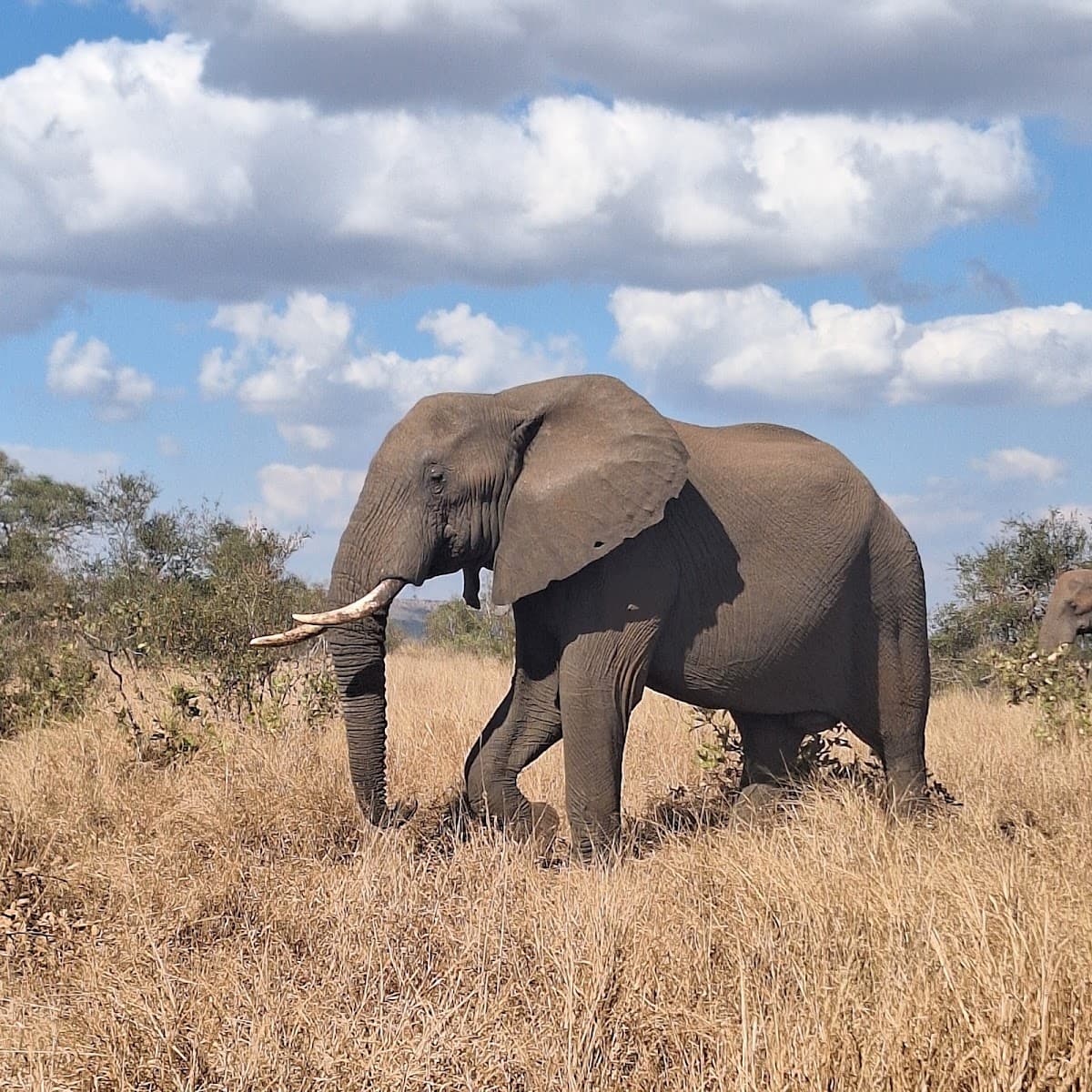
Kruger National Park
Africa's premier safari destination with Big Five
Kruger National Park isn't just another safari destination — it's the gold standard. Spanning nearly 20,000 square kilometers of South African wilderness, this legendary park delivers what every wildlife enthusiast dreams of: lions lounging under marula trees, elephants crossing dusty roads just meters from your vehicle, and leopards draped across acacia branches like living art.
But here's what makes Kruger special: accessibility. You don't need a specialized guide or expensive tour operator to spot the Big Five. Self-drive safaris put you in control, letting you linger at waterholes where rhinos gather at sunset or follow a pack of wild dogs on their morning hunt.
The park's southern section around Skukuza offers the highest game density, while the remote northern reaches near Punda Maria provide solitude and unique bird species. And unlike many African parks, Kruger operates year-round with excellent infrastructure — paved roads, rest camps with restaurants, and even cell phone coverage in main areas.
Sure, it gets busy during peak season. But wake up early, head out before sunrise, and you'll have the best sightings to yourself while other visitors are still drinking coffee.
Best Months
MAY – OCT
~24°C · moderate crowds
Culture & Context
SHANGAAN RECKONING
Kruger sits in the traditional homeland of the Shangaan (Tsonga) people, who have been connected to this land for centuries. The park's 2026 centenary is not just a celebration. It's also a moment of honest reckoning.
SANParks and the South African government are openly acknowledging that Kruger's conservation history was shaped by land dispossession, and the centenary dialogue at Africa's Travel Indaba 2026 centered on making conservation more inclusive and community-driven. The dominant local culture around the park is Shangaan, with the Shangana Cultural Village on the R535 Graskop Road near Hazyview serving as a living, community-run space for visitors. The Shangaan people speak isiTsonga, one of South Africa's 11 official languages.
Many camp staff and guides are Shangaan, and the culture runs through everything from the evening boma fires to the food served at lodges.
Local Customs
BRAAI & BOMA
Braai culture is non-negotiable. A braai is a South African BBQ, and doing one at your campsite is basically part of the entry fee in spirit. All major camps have braai facilities.
Bring your own charcoal or buy at camp shops.. The boma dinner is a Kruger evening staple. Lodges gather guests around a fire in an enclosed outdoor area for communal dinners under the stars, often with traditional dishes like potjiekos (slow-cooked stew), boerewors sausage, and pap (maize porridge)..
Gate times are law. The park gates open and close on a strict schedule that changes seasonally, and being caught driving after hours results in a fine. Check the SANParks website for current times before every outing..
Strictly no feeding wildlife, not even the monkeys and baboons at camp. This is both a rule and a serious safety point. Baboons in particular are notorious for breaking into cars and tents the moment you turn your back..
Elephants have right of way. Always. Stop the car, turn off the engine, and wait.
Do not hoot, rev, or crowd them. They can and do charge vehicles.. No drones inside or over the park.
This is strictly enforced.. Alcohol is not permitted for day visitors entering the park. Overnight guests can drink within camps but not in public areas or on game drives..
The Shangaan Evening Festival at Shangana Cultural Village near Hazyview is worth planning around. Guests are welcomed into the Chief's Kraal with drumming, traditional dancing, and a meal that includes dishes like crocodile strips in peanut sauce and mopane worms.
Safety
MALARIA MANDATORY
Malaria is real and not optional to consider. Kruger is a malaria-risk zone year-round, with high season from October to May and peak risk from January through May. The NICD has flagged above-average malaria cases in surrounding Limpopo and Mpumalanga provinces.
Consult your doctor before travel about prophylactics. Malarone is currently the most popular choice for travelers due to minimal side effects, but get proper medical advice for your situation. At dusk, cover up.
Long sleeves, long trousers, spray ankles and ears with DEET repellent. All park accommodation has netted screens. Wildlife safety: camps are fenced and gated, and wildlife inside camps is generally limited to baboons, monkeys, and the occasional visiting elephant.
Never leave food out. Never get out of your vehicle in the open bush outside designated areas. Crime inside the park itself is not a significant concern.
However, Johannesburg (the main international gateway) requires standard big-city caution. O.R.
Tambo Airport sits on the eastern outskirts along the main road to Kruger, so you can go directly from airport to park without entering the city. Pregnant visitors are advised by medical authorities to seriously consider malaria-free alternative reserves.
Getting Around
SELF-DRIVE SAFARI
Kruger is about a 5-6 hour drive from Johannesburg's O.R. Tambo International Airport.
The closest gate, Numbi Gate, is roughly 375km from the airport. You can fly into Skukuza Airport (inside the park) or Hoedspruit/Eastgate Airport if you want to skip the road trip entirely. The park has nine entrance gates.
Paul Kruger Gate near Skukuza is the busiest and most popular for southern Kruger. Phabeni Gate near Hazyview is convenient for visitors coming from the Panorama Route, though note the Phabeni Road (S1) is closed for repairs in 2026 with an alternate route in use. Inside the park, all driving is on designated tar and gravel roads.
Speed limits are 50 km/h on tar and 40 km/h on gravel. Off-road driving is a serious offence. Renting a car in Johannesburg and self-driving is the most popular option and gives you maximum flexibility.
An SUV or larger vehicle is recommended for comfort and ground clearance on gravel roads. Fuel is available at main rest camps and accepts card payment. No cash required for fuel.
Note: if you get a flat tire near elephant dung on the road, that's a known hazard since elephants eat thorn bushes and the thorns pass through.
Useful Phrases
Where to Stay in Kruger National Park
5 recommended properties
Silvan Safari Lodge
ultra-luxury · Bohemian-luxe contemporary — art-forward, maximalist in palette but architecturally minimal. Think copper bars, oversized daybeds, patchwork rugs, hand-woven chair-nests hanging from jackalberry trees, and a gin bar with over 100 bottles.
Londolozi Game Reserve
ultra-luxury · Soulful, conservation-led luxury. This is four generations of a single family hosting guests in the African bush — campfire rituals, ranger-guides who know every animal by name, and an ethos that puts the land first. Expect genuine warmth, not corporate polish.
Honeyguide Tented Safari Camps
luxury · Authentic bush safari with modest luxury — canvas walls, communal boma dinners, dawn drumbeat wake-ups. Not a five-star spa resort. The no-fence policy means elephants genuinely walk through camp to drink from the pool.
Royal Malewane
ultra-luxury · Classic African bush luxury with bold design personalities across lodges — think antique four-poster beds and teak decks at Malewane, fuchsia and turquoise splashes at Waterside, and canvas-meets-colour at Masiya's Camp. The overall feel is personal and unhurried rather than corporate-hotel polished.
Lukimbi Safari Lodge
luxury · Classic African bush lodge with sophisticated interiors — carved plaster panels, stone bathtubs, cathedral windows, and an artistic fireplace engraved with animal designs. Colonial romance done tastefully, not kitschy.
Itineraries coming soon
We're working on adding amazing itineraries for Kruger National Park. In the meantime, try the app to create your own!
Money-Saving Tips
- 1.Buy a Wild Card for R2,655 if visiting more than 5 days - covers all South African national parks
- 2.Self-drive safaris cost fraction of guided tours while offering more flexibility and time at sightings
- 3.Bring your own food and drinks - rest camp restaurants charge tourist prices for average meals
- 4.Fill up at Skukuza or Satara fuel stations - cheapest options inside the park
- 5.Book accommodation 11 months ahead or hunt for cancellations to avoid premium rates
- 6.Visit during shoulder seasons (May-June, September-October) for lower accommodation costs with excellent game viewing
Travel Tips
- •Download the Kruger National Park app for real-time animal sighting reports from other visitors
- •Leave camp before sunrise for best Big Five sightings - most animals are active in cool morning hours
- •Drive slowly (25 km/h max) and scan tree lines, not just the road - leopards rest in branches during day
- •Pack malaria prophylaxis from October through May - consult travel clinic 6 weeks before departure
- •Bring binoculars - even budget 8x32 models transform distant wildlife into detailed encounters
- •Stay overnight inside the park - day visitors miss magical sunrise and sunset game drives
- •Follow the H4-1 road between Skukuza and Lower Sabie for highest game density and Big Five sightings
Frequently Asked Questions
Explore Kruger National Park
BUILD YOUR
KRUGER NATIONAL PARK PLAN
Insider picks, smart timing, and a plan ready when you are.
Start Planning