Catskills Hudson Valley
More layers than most people expect.
Culture & Context
BORSCHT BELT REBORN
This region has more layers than most people expect. Metro New Yorkers have been coming here since the 1800s, first on steamboats and mountain railroads, then to the legendary Jewish resorts of the 1920s-1970s Borscht Belt (think Grossinger's, The Concord) where comedians like Mel Brooks, Rodney Dangerfield, and Milton Berle got their start. All of that is immortalized in shows like The Marvelous Mrs. Maisel. Then there's the Hudson River School of landscape painters who made these mountains famous in American art. Washington Irving set Rip Van Winkle here. The 1969 Woodstock festival happened nearby (actually in Bethel, not Woodstock itself). And now? A whole new wave has arrived. Locals call them "Hicksters" — hipsters from Brooklyn and Manhattan who've moved upstate for slower living, and brought serious farm-to-table restaurants, craft cideries, boutique hotels, and natural wine shops with them. The COVID exodus from NYC turbocharged all of it. The result is a place where old-guard mountain families, fly-fishers, and artists share space with Brooklyn expats and weekend Airbnb crowds. It works, mostly. The region spans four counties — Delaware, Greene, Sullivan, and Ulster — within or near the 700,000-acre Catskill Forest Preserve. America's 250th anniversary (RE250) events are running throughout 2026, adding patriotic festivals and historical reenactments to the usual summer calendar.
cultural_context_headline: BORSCHT BELT REBORN
Local Customs
Bring cash — local farm stands, small diners, and roadside cideries often don't take cards.
ATMs in small mountain towns can be scarce.. Leave No Trace is taken seriously here.
Pack out your trash, stay on marked trails even when muddy, and don't trample vegetation. DEC rangers and trail stewards actively patrol popular spots.. Don't post secret swimming holes online.
This is a genuine, deeply-felt local norm. If someone tells you about a secluded spot, keep it to yourself.. Tip 18–20% at restaurants, especially in smaller towns where servers are often supporting a tight local economy..
Farmers markets run Sunday mornings in summer — New Paltz has one every Sunday. Show up early for the good stuff; vendors sell out.. The pace here is intentionally slow.
Don't honk, don't rush service, don't expect city speeds. That's the whole point of being here.. Hunting season (fall/early winter) is real.
Wear blaze orange if hiking in October–November in rural areas, especially in Delaware and Sullivan Counties.. Brewpubs like Catskill Brewery in Livingston Manor function as community anchors, not just tourist stops. Regulars know each other.
Be friendly.. Fire pits at rentals are part of the culture — but check local burn bans before lighting up, especially in dry summers.
Safety
VERY SAFE
Crime is low across the Catskills and Hudson Valley. This isn't a place where you need to watch your back in most towns. That said, the real safety concerns here are outdoors. Trails can be rugged and conditions change fast — a 30°F temperature swing between valley mornings and summit afternoons is normal. Always carry layers, a rain shell, and a physical paper map because cell service genuinely drops in the mountains. Before hiking, let someone know your route and expected return. Lock your car at trailheads (petty theft from parked vehicles does happen at popular spots like Kaaterskill Falls). The Peekamoose Blue Hole requires permits May 15–Sept 15 because of how badly overrun it got. Don't cross streams after heavy rain — DEC rangers get called out regularly for rescues on flooded trails. Water at falls and swimming holes looks clean but don't drink untreated. One more thing: don't post the location of secret swimming holes online. Locals genuinely hate this, and several once-pristine spots have been ruined by the Instagram crowd. Earn that info the old-fashioned way — talk to people.
safety_headline: VERY SAFE, HIKE SMART
Getting Around
CAR IS KING
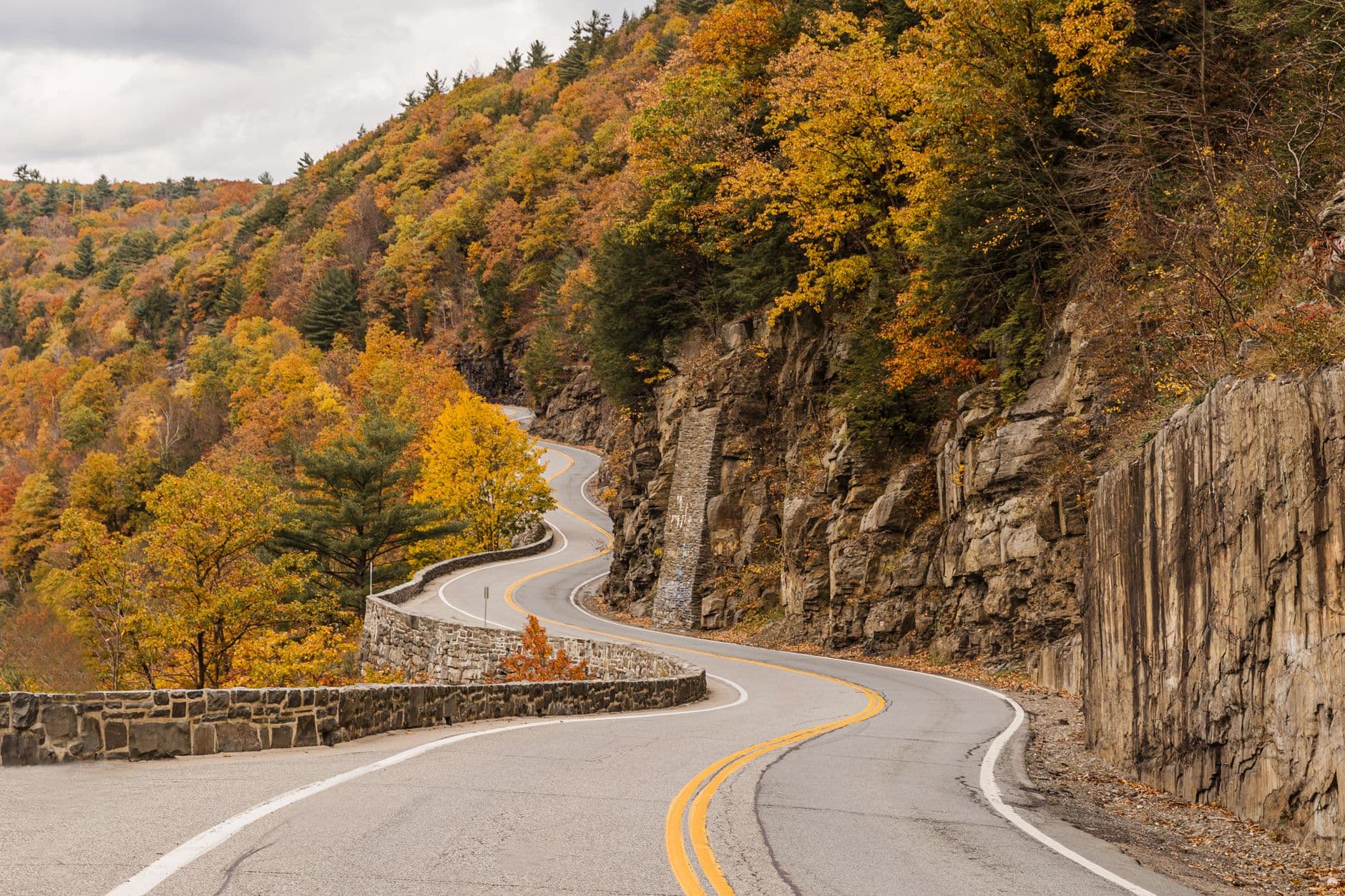
You can get here without a car — Amtrak runs from Penn Station to Hudson (about 2 hours, $30–70), Metro-North Hudson Line reaches Poughkeepsie (~$35, 3.5 hours from Grand Central), and Trailways buses run from Port Authority to Catskill once daily (~$26–85, 2h40m). But once you arrive, a car is nearly essential. Public transit within the Catskills is thin. Greene County Transit runs a Line 711 bus between Catskill and Hudson (4x/day weekdays only, $3), and Ulster County Area Transit covers some routes, but the mountain towns like Phoenicia, Woodstock, Hunter, and Livingston Manor are all car-dependent. Rideshares work as a last-mile option from train stations but can be unpredictable in remote areas. The serious move is to rent a car at a train station (Avis, Budget, and Enterprise are available at Sullivan County International Airport). If you're driving from NYC, it's roughly 2–2.5 hours depending on your target town. The Catskill Scenic Trail (known locally as "the Rail Trail") connects several villages for hikers and bikers — Hobart, Stamford, and Bloomville all have access points. Mountain bikes are also permitted on certain DEC dirt roads. Budget for gas and tolls if coming from the city via the NY Thruway (I-87).
transport_headline: CAR IS KING
Useful Phrases
BUILD YOUR
CATSKILLS HUDSON VALLEY PLAN
Insider picks, smart timing, and a plan ready when you are.
Start Planning