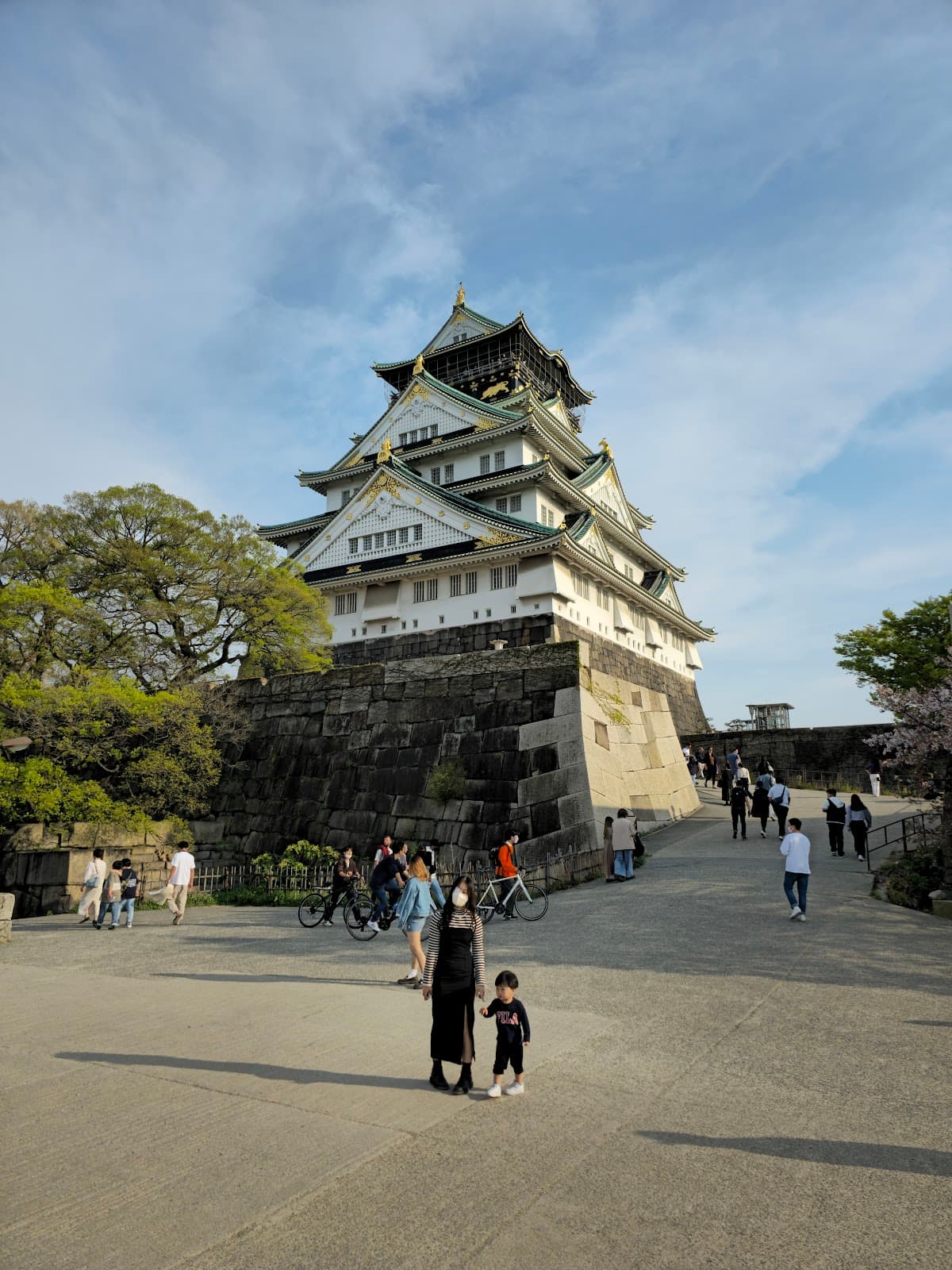
Osaka Castle Area
Where samurai legacy meets modern Japan's beating heart
The massive stone walls rise 40 meters above Osaka's skyline, but here's what most visitors miss: Osaka Castle Area isn't just about the reconstructed keep. This sprawling district wraps around Japan's most famous fortress with cherry-lined paths, underground shopping labyrinths, and some of the city's best family attractions. You'll find 600-year-old foundations next to gleaming skyscrapers, traditional tea houses beside convenience stores selling hot takoyaki. The contrast hits you immediately - samurai history literally surrounded by modern Japan's beating heart.
Culture & Context
LOUD, FUNNY, FOOD-OBSESSED
Osaka has a distinct personality compared to the rest of Japan — louder, funnier, more direct. The local "kuidaore" spirit (literally "eat until you drop") isn't just a tourism slogan. People here genuinely live by it. Osaka has historically been a merchant city, and that background shaped an outgoing, pragmatic, food-obsessed culture where talking to strangers about where to find good takoyaki is completely normal.
The city speaks its own dialect, Osaka-ben (a version of Kansai-ben). Intonation is more melodic and expressive than Tokyo Japanese — what goes up in pitch in Tokyo falls in Osaka, and vice versa. Most of Japan's famous comedians come from the Kansai region, and that DNA runs through daily life. Expect more banter, more warmth, and more personality from locals than you'd typically encounter in Tokyo.
Here's the thing about Osaka vs. Kyoto: Kyoto has the refined, graceful reputation. Osaka owns the "friendly, a little rough around the edges, genuinely welcoming" one. First-time visitors to Japan are sometimes surprised by how approachable locals feel here. Lean into it.
Local Customs
NO TIPPING EVER
No tipping — ever. In restaurants, taxis, hotels, anywhere. It's not expected and may be awkwardly refused.
Great service is the standard, not something to be rewarded with extra cash. A clear 'arigatou gozaimasu' is the right move.. Escalators in Osaka: stand on the RIGHT, walk on the LEFT.
This is the opposite of Tokyo. Get it wrong and you'll block traffic immediately.. Eating while walking is generally frowned upon — especially outside of festival zones, street stalls, and designated eating areas.
If you buy takoyaki from a stall, stand to the side and eat it there.. Izakaya table charge (otoshi): small mandatory appetizer appears automatically when you sit down, and it costs ¥300–500. This is normal.
Don't try to refuse or return it.. Public transport is quiet. Talking loudly, taking phone calls, and playing audio without headphones are all considered rude.
Keep it down.. No photography of locals without permission. Tobita Shinchi (the traditional red-light district) strictly enforces a no-camera rule — breaking it can lead to confrontation..
At Shinto shrines, rinse hands at the temizuya (water fountain) before approaching the main hall. Bow twice, clap twice, pray, bow once more. Just watch locals if you're unsure..
Cash is still king at many small restaurants, especially family-run spots. Keep ¥5,000–10,000 on you at all times. 7-Eleven ATMs take foreign cards reliably..
Tattoos can be a problem at onsens and some gyms. Many establishments still prohibit entry. Some places allow covered tattoos; others don't.
Check in advance.
Safety
WATCH PETTY THEFT
Osaka is one of the safest major cities on earth. Full stop. The crime index sits at just 13.7 (safety index of 86.3 as of 2026), and violent crime is extremely rare, with rates below 0.3 per 100,000 residents. The US State Department maintains a Level 1 advisory for Japan — the lowest possible concern level.
That said, petty theft has been rising in the busiest tourist corridors. Dotonbori and Namba after dark, along with Umeda Station, are the spots where distraction-based theft clusters. Keep bags zipped and in front of you on crowded trains and in packed nightlife areas. Don't leave your phone on a restaurant table.
Specific area notes: Tobita Shinchi (traditional red-light district) has a strict no-camera rule that will be enforced if you break it. Dotonbori's back alleys after 2am attract rip-off bars — aggressive promoters outside unmarked venues are a red flag. The Kamagasaki district (Nishinari Ward) and parts of Naniwa Ward have historically higher crime rates; not dangerous for daytime visitors but worth awareness at night.
Natural disasters are the bigger concern than street crime. Japan is one of the world's most seismically active countries. Download the Safety Tips app from the Japan Tourism Agency before arrival for real-time earthquake and typhoon alerts. If an earthquake hits, follow evacuation signs in hotels and public spaces — they're multilingual and well-maintained. Emergency numbers: Police 110, Fire/Ambulance 119, Tourist Hotline (24hr, multilingual) 050-3816-2787.
For medical costs: Japan charges non-residents full rates. Emergency room visits run ¥15,000–30,000 before treatment begins. Travel insurance that covers medical emergencies is not optional.
Getting Around
METRO & ICOCA CARD
The Osaka Metro is your primary tool. Nine subway lines cover the city comprehensively and trains run clean, on time, and frequently. Get an ICOCA card at Kansai Airport or any JR West station vending machine. Cost is ¥2,000 total (¥1,500 usable credit + ¥500 refundable deposit). Tap in and out at every station — if you forget to tap out, you'll need to visit the station control office to reactivate the card. Top up at station machines or at any 7-Eleven ATM.
For day trips around Kansai, the same ICOCA card works on Hankyu, Hanshin, Keihan, Nankai, and Kintetsu private rail lines as well as all bus routes. You can also use any Suica or Pasmo loaded on your phone.
For weekend visitors or heavy sightseeing days, the Eco Card day pass (¥620 weekends, ¥820 weekdays) covers unlimited Osaka Metro and city bus rides. It breaks even after three trips. The Osaka Amazing Pass (¥3,500 for one day, ¥5,000 for two days) covers transport AND entry to major attractions — worthwhile if you're hitting three or more paid sights in a day.
Women-only train cars operate all day on weekdays on the Midosuji Line, and on weekday mornings only (first train until 9am) on the Tanimachi Line. Check platform signage carefully — rules differ by line and time.
One practical note for escalators that catches people off guard: Osaka stands on the RIGHT, walks on the LEFT. This is the opposite of Tokyo. Get it wrong immediately and you'll block commuter traffic.
Taxis are metered, professional, and don't overcharge — but they're significantly more expensive than the subway. Use the GO app for on-demand taxi booking. Airport access from Kansai International Airport: the Haruka Limited Express to Shin-Osaka takes about 50 minutes (¥2,330 regular fare). The ICOCA + Haruka combo ticket available at KIX offers a discount on the airport train plus a loaded IC card.
Useful Phrases
Money-Saving Tips
- 1.Castle admission costs ¥600, but the surrounding park and grounds are completely free
- 2.Combine your visit with Osaka Museum of History next door - joint tickets save ¥200
- 3.Pack snacks from convenience stores rather than buying overpriced food inside the castle
- 4.Take the subway instead of taxis - it's ¥230 to most destinations vs ¥1,000+ for cabs
- 5.Visit during weekdays when many restaurants offer lunch sets under ¥800
- 6.The castle illumination is free to view from outside the grounds after closing time
- 7.Download the free Osaka Castle app for audio guides instead of renting the ¥500 devices
Travel Tips
- •Arrive by 9am to beat tour groups and get the best photos without crowds
- •Wear comfortable walking shoes - the castle approach involves steep stone steps
- •Bring a portable phone charger - you'll be taking photos constantly
- •The castle keep has no elevator - skip it if you have mobility issues
- •Cherry blossom season requires advance hotel bookings 6 months ahead
- •Learn basic Japanese phrases - English signage is limited outside the main tourist areas
- •Download Google Translate with camera function for reading restaurant menus
- •The castle grounds close at different times seasonally - check current hours online
Frequently Asked Questions
BUILD YOUR
OSAKA CASTLE AREA PLAN
Insider picks, smart timing, and a plan ready when you are.
Start Planning